
Bluesky’s Political Threat Problem: A Regulatory Gap with Real-World Consequences
By Dalia Serr and Daniella Spoto
Abstract
Bluesky was found to host six times more death and violent threats against UK party leaders and senior ministers than X between 2024 and 2026, a gap that widens to roughly 58-fold when normalised for each platform's politically engaged UK user base. Using statutory definitions of death threats and violent harassment, this report tracked qualifying posts across both platforms and found threats rising sharply year-on-year, with a 358.3% increase in violent threats on Bluesky between late 2024 and 2025. While death threat rates were similar on both platforms, X showed stronger enforcement through observed takedowns and published transparency data, while comparable content on Bluesky, some dating to 2024, remained publicly accessible. This gap stems from structural weaknesses in Bluesky's moderation: an API that blocks full-text search, undermining both community and in-house moderation, and terms of service that claim proactive enforcement while disclaiming any obligation to monitor content. The report concludes that Bluesky's moderation model fails to meet the duties set out in the Online Safety Act 2023, leaving politicians and the public exposed to escalating threats on a platform with a disproportionately political user base, and proposes policy recommendations to close this regulatory gap.
Introduction
Violence, death threats and severe abuse against MPs are not a new phenomena, yet they have escalated dramatically through social media. The 2016 murder of MP Jo Cox, who had reported receiving malicious communications, including threats and harassment prior to her murder, marked a watershed moment in understanding online abuse’s real-world consequences. Ten years later, MPs continue to experience severe daily online threats and abuse, with reported crimes against MPs more than doubling since 2019[1]. In 2019, Jess Phillips reported that in one night she received more than 600 rape threats[2].
This escalation stems from a specific mechanism: polarised and divisive social media content pushes individuals towards the extreme fringes of the political spectrum, intensifying hatred towards those with opposing views[3]. Simultaneously, the democratisation of media content creation has enabled the spreading of misinformation, violent rhetoric and extreme content. These forces create an environment where online abuse has the potential to translate into offline harm[4].
In response, the UK government enacted the Online Safety Act 2023[5]. This regulatory framework set out clear legal rules for websites and social media platforms to prevent and remove illegal content. The act came into effect on July 25, 2025, with platforms obligated to complete risk assessments and protect users from illegal content such as terrorism and harassment from March 2025[6]. X and Facebook have largely moved towards compliance, implementing age verification tools alongside content moderation changes, though significant gaps remain. However, a more concerning new platform has emerged: Bluesky. Launched in 2024 as a decentralised alternative to X, Bluesky positions itself as “social media as it should be”[7] and has attracted millions of users, particularly popular amongst politically engaged left-leaning audiences seeking escape from X’s toxicity[8].
Through extensive advanced searches comparing the prevalence of death threats, severe abuse and violent threats towards UK party leaders and senior ministers on X and Bluesky, we uncovered an extensive lack of oversight and meaningful content moderation on Bluesky, exemplified by the number of concerning death threats dating back to 2024, when the platform was first launched. Despite common assumptions that X is unmoderated chaos, X maintains a substantially stronger enforcement and transparency framework than Bluesky. Bluesky hosts an extensive archive of violent threats targeting UK politicians, many dating back to 2024, that remain publicly accessible despite clearly defying its community guidelines. These findings are of particular significance given Bluesky’s rapid political importance in the UK, with spikes in usage aligning with key political events.
This report argues that Bluesky’s decentralised moderation model fails to meet the statutory duties set out in the Online Safety Act of 2023. Crucially, the platform presents an emerging regulatory blind spot due to its actively politically engaged users. As long as Bluesky remains unaccountable, lacking thorough oversight and moderation processes, politicians and the public using it primarily as a political platform remain exposed to threats of violence, death and severe abuse.
Methodology
When commencing this research, we intended to understand whether there had been an increase in online political violence. We chose to compare X and Bluesky. Bluesky interested us due to its decentralised model and political audience. X felt like a fitting comparison due to its reputation for being an unmoderated ‘free speech’ platform. Moreover, the comparison interested us as Bluesky was created by Jack Dorsey, the founder and CEO of Twitter[9]. Interestingly, Musk’s purchase of the platform saw many of its users leave X and flock to Bluesky. Whether that was because of a disdain for Musk or a desire to join a decentralised platform, this highlighted to us that Bluesky has been a political platform from this point onwards. As a result, we decided to investigate whether there had been a rise in political violence on both of these platforms.
As the scope of our report deals with the illegalities of posts made on Bluesky and X, we decided it would be most appropriate to measure these posts against the legal threshold for death threats and violent threats. Hence, we used section 16 of the Offences Against the Person Act 1861 to define ‘death threat’[10]:
It is illegal to threaten to kill another person (or a third party) without a lawful excuse, with the intent that the person threatened will fear the threat will be carried out
As no definition for a ‘violent threat’ exists in statute, we decided the definition of violent harassment taken from section 4 of the Protection from Harassment Act 1997[11]:
A person commits an offence if their course of conduct causes another to fear that violence will be used against them, and they know or ought to know this
It was concluded that this is the most appropriate definition for our research as it specifies that the user does not need to have the explicit knowledge at the time of posting that they are committing a crime. This allows the focus to be on the liability of the platform in failing to censor these accounts and posts, as well as the ultimate failure: removing the post.
Once the definition was agreed upon, the terms used to find threatening posts on X and Bluesky were consequently discussed. This is the finalised list:
‘Kill, Die, Death, Shoot, Hang, Rot, Burn, Hell, I will find you, I will hunt you’
The two platforms differ in their methods of advanced search. On X, we were able to paste our list of key terms into the ‘Any of these words’ section of the advanced search. Whereas Bluesky does not have this feature, we had to manually search for each term by pasting ‘Kill’ AND ‘Politician’s name’ in the search bar. However, both platforms allowed us to filter the date and language. As a result, we filtered all posts to be in English and set the dates to be between the 6th of February 2024 and 19th July 2026. As Bluesky has only been operational since February 6th, 2024, choosing this date would give us the largest window for data collection. 19th of July was selected as this was the day before Andy Burnham’s premiership commenced. By extending our window beyond the 19th of July, we shared the concern that data would not be representative of a full-term premiership.
We looked at all mainstream party leaders (Labour, Conservative, Liberal Democrats, Green, Reform UK and Restore Britain) as well as their respective senior ministers. This was to understand whether political violence spanned the political spectrum as opposed to heavily directed towards the right or left or whether it was targeted at the Prime Minister.
Data collection consisted of manually scrolling through all search results and extracting the posts which meet our thresholds for all party leaders.
This data was compiled on an Excel spreadsheet; the categories logged were the name of the politician, the date posted, the post content, the link to the post and the category of the threat. After data collection finished, the summary feature on Excel was employed to provide us with the total number of threats per year and platform, as well as the total for each category of threat.
Findings
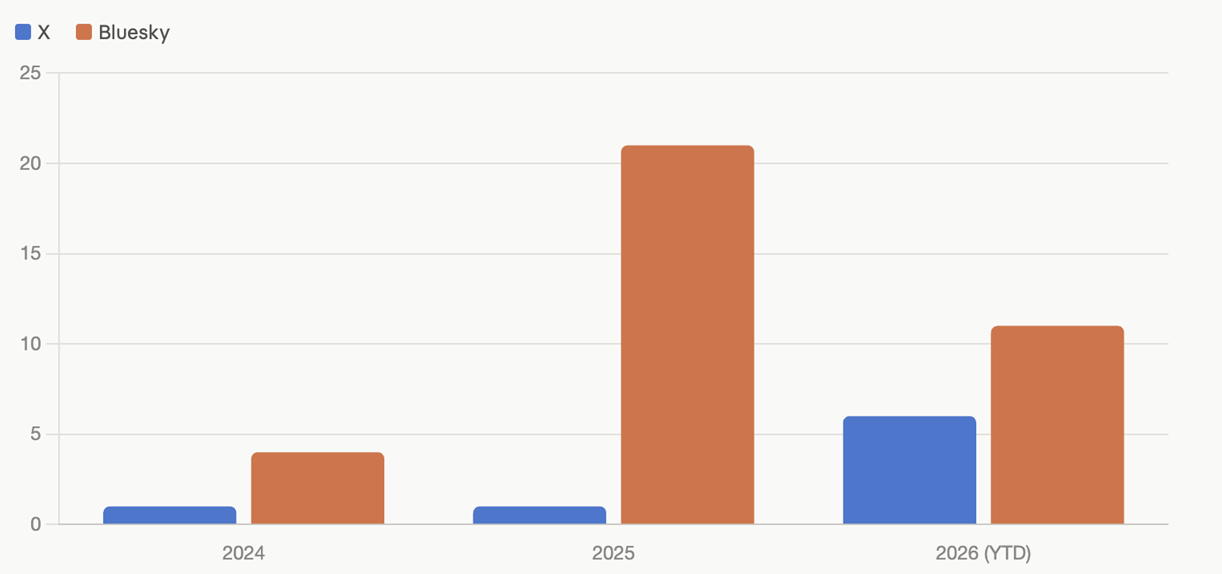
The most revealing statistic found was that the number of threats posted on Bluesky was 6x greater than the number posted on X within the critical period. This difference persisted each year, with the largest divergence in 2025.
Total number of threats logged between X and Bluesky
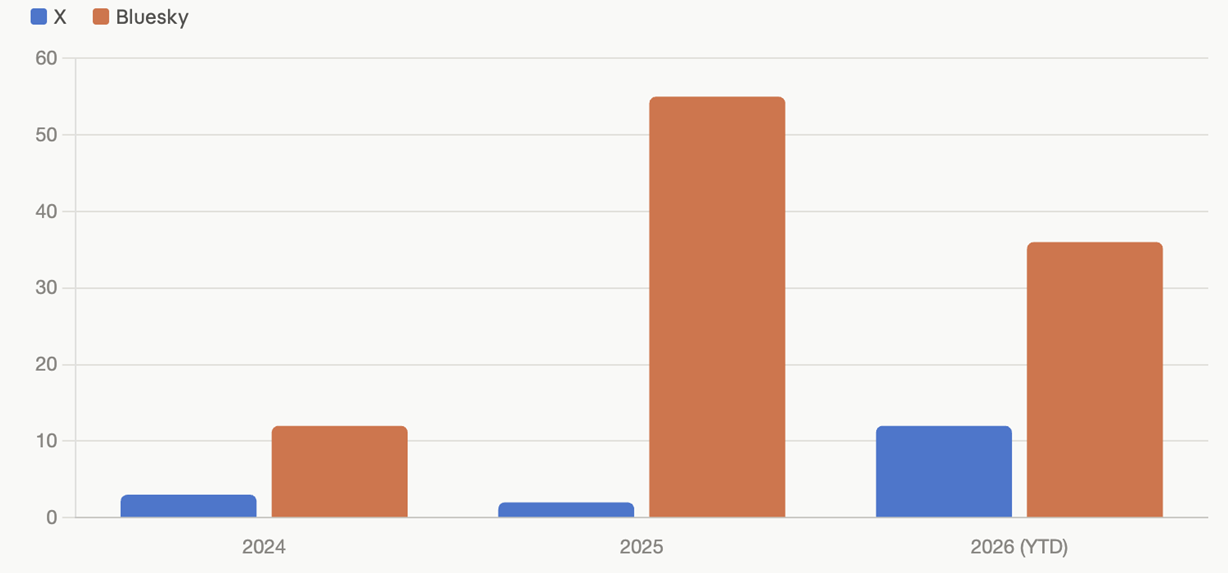
The second of the primary findings is the increase in threats posted year on year. Regardless of the platform, there is a clear increase in threats posted, with a percentage increase of +220% from 2024 to 2026, and a 240% increase in death threats within this period. It could be assumed that this is symptomatic of the environment social media creates[12].
The stark difference between the two platforms in 2025 is the dataset most reflective of how these platforms operate. In the course of collecting this data, we noticed five threats were removed on X; we did not witness the same pattern on Bluesky. At the time of writing this report, the increase from two threats to twelve threats on X (2025-2026) seems alarming, although we assume the total will settle as the year continues, mirroring 2024 and 2025 due to X’s stricter user policy. This tells us that threats are being posted on Bluesky and X alike, however, X’s regulation model is effective. Therefore, we predict Bluesky’s numbers will continue to rise in 2026, whilst X’s numbers likely fall.
Nigel Farage received the most threats (48) with Keir Starmer receiving 33 in total. Farage received the most threats on Bluesky (46) compared to as little as 1 on X. Keir Starmer follows the same pattern receiving 25 on Bluesky compared to 8 on X.
Number of threats per MP, comparing Bluesky and X
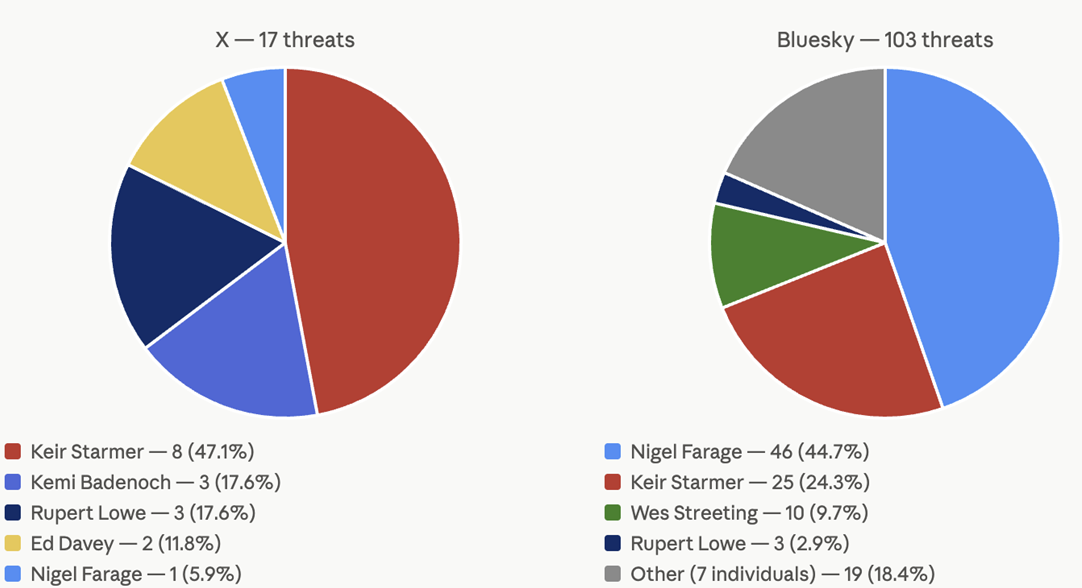
Despite the disparity in the statistics, the language used in the threatening posts remains similar. There were no patterns in the type of violence incited between the two platforms. Additionally, the rate of death threats between the two platforms did not differ largely. Of the 103 threats tracked on Bluesky, 36 were concluded to be death threats, compared to 8 out of 17 found on X. It is no secret that death threats are being posted online; therefore, this finding is not remarkable. However, it should be noted that whilst the rate remains similar, the difference in the total number of death threats highlights that the tools X employ to terminate users who post threats, as well as removing the threats themselves, are more effective than those used by Bluesky.
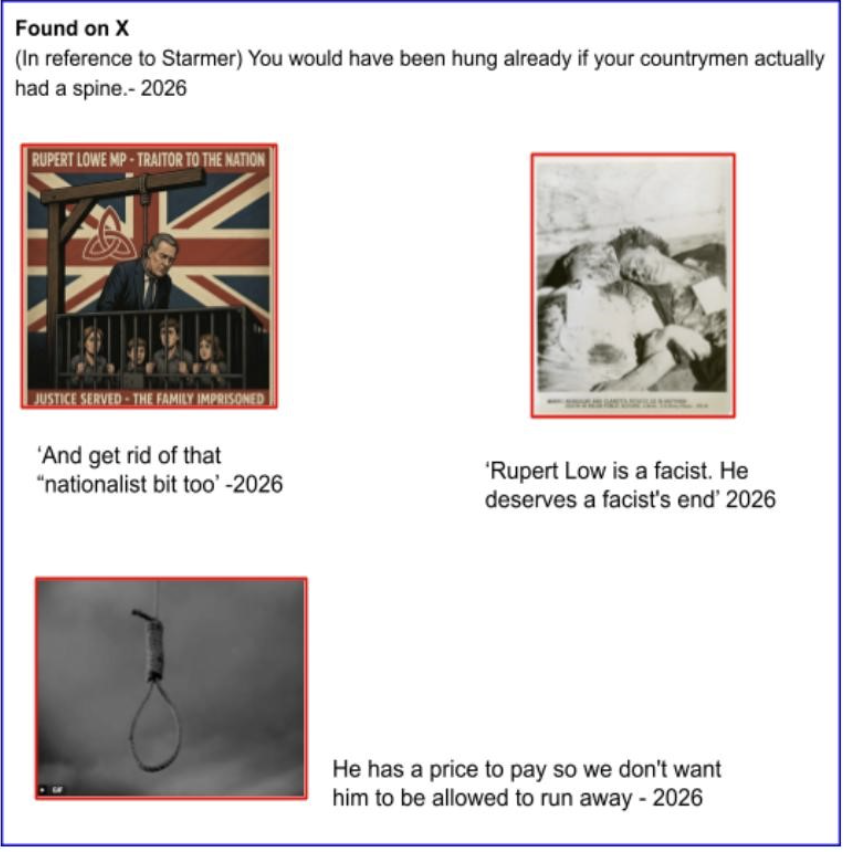
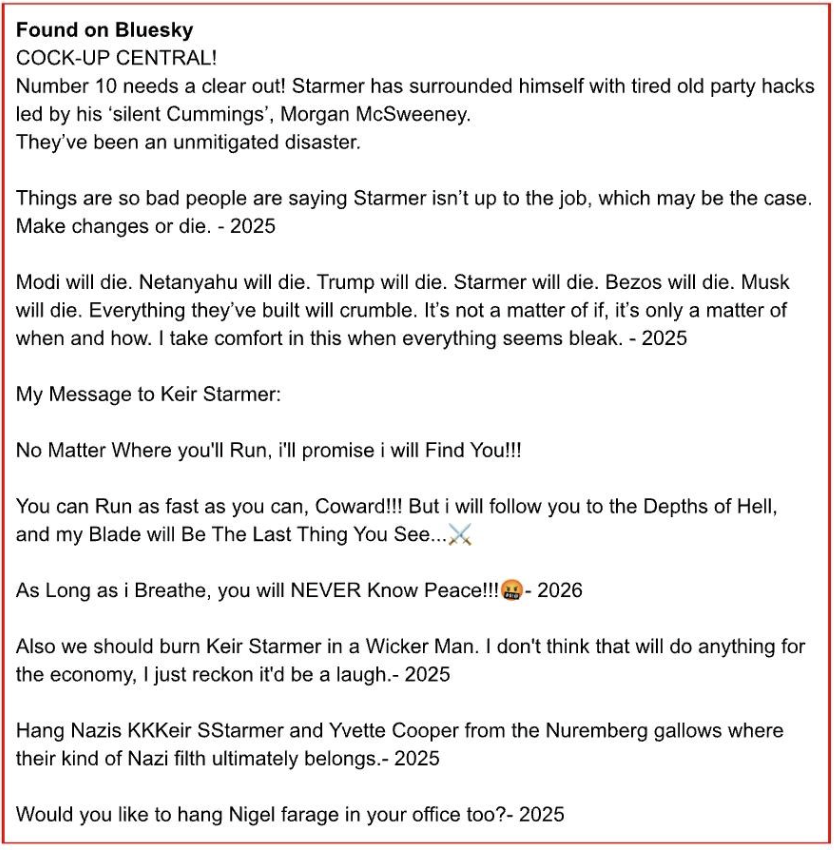
Examples of these threats can be found in the tables below:
Total number of death threats between Bluesky and X
Normalising for audience size
While the raw comparison shows Bluesky hosting six times more threats than X, this raw count does not account for the vastly different size of each platform’s UK political audience. Normalising for audience size produces a substantially larger disparity, not a smaller one.
Bluesky’s own reported figures put the platform at 43.5 million registered users globally as of April 2026[13], with the UK accounting for an estimated 3.8% of platform traffic[14], giving an estimated UK user base of approximately 1.65 million. Using this report’s earlier finding that 84% of Bluesky users follow politics closely[15], this suggests there are approximately 1.39 million politically engaged UK users.
X’s user base is estimated at approximately 23 million UK users[16], it should, however, be noted that X no longer discloses verified active-user figures, with public estimates relying on ad-reach data rather than audited figures[17]. Applying the 58% political-engagement rate cited earlier[18] gives an estimated 13.3 million politically-engaged UK users on X.
Normalising the raw threat counts against these estimated audiences produced a rate of approximately 7.4 threats per 100,000 politically engaged users on Bluesky, compared to approximately 0.13 threats per 100,000 politically engaged users on X, a disparity of approximately 58 times. This normalised figure should be read as an estimate rather than a precise measurement, given the uncertainty of publicly available platform-wide user statistics, particularly for X.
It is also notable that neither Nigel Farage nor Keir Starmer maintain an authentic, active presence on Bluesky. Farage’s account on the platform is a parody account[19], while Starmer has publicly stated he has no plans to join the platform[20]. This indicates that the threats identified in this research are not directed replies to the politicians’ own posts but rather represent general discussion generated by Bluesky’s user base. This reinforces the concern that this reflects a broader community pattern rather than isolated interactions with the politicians’ own accounts.
Discussion
Terms and conditions
Bluesky operates a dual moderation system: a ‘decentralised form of moderation’ “allowing anyone to use, run and contribute to improving” labelling of harmful content, and in-house moderation[21] “to provide a strong foundation that upholds our community guidelines”. However, both systems suffer significant limitations in their capacity to effectively moderate the platform.
The decentralised moderation system is fundamentally undermined by Bluesky’s API architecture. The official Bluesky API prevents users from conducting full-text searches, meaning violent, abusive or threatening language is often never indexed and cannot be retrieved through the API even when the content is publicly visible on the platform. This architectural barrier effectively disables community-driven moderation as users cannot flag or identify content they cannot search for.
Ozone is Bluesky’s open-source moderation framework a key component of their community-based moderation[22], it is designed to allow third-party groups to run their own labelling services to help moderate content. However, Ozone does not provide full-text search, meaning it cannot index all posts and therefore cannot retrieve violent or illegal content at a large scale. As a result, Ozone faces the same limitations as Bluesky’s API community moderators cannot label content that is not readily available to them.
Bluesky’s in-house moderation similarly fails to uphold its stated community guidelines. Under “Respectful Discourse”, Bluesky explicitly prohibits: (i) threats of death or serious harm, or expressions that others should be hurt or killed; (ii) content promoting, glorifying or inciting violence against individuals or groups. Under “Anti-Harassment,” it prohibits harassment and toxic behaviour[23]. Yet research demonstrates a wide range of posts violating these categories remain readily available on the platform, some dating back to 2024/2025 and early 2026.
This enforcement gap is further compounded by Bluesky’s contradictory terms of service. Bluesky states that they:
We proactively use automated tools and human moderation to detect and act on prohibited content. Bluesky prioritizes the swift removal of terrorism content, child sexual exploitation and abuse (CSEA) content, and other priority illegal content. This proactive technology includes tools that help us recognize hashes of known illegal content and that can detect violations of our terms based on the text in and content of a post. We also rely on user reports, trusted flaggers, law enforcement reports, and reports we receive from NGOs and civil society. When notified, we act swiftly to minimize exposure.
And yet the terms simultaneously declare that “Bluesky is not obligated to actively monitor or control your Content”[24]. This contradiction creates a legal loophole the platform claims to operate proactive moderation while explicitly reserving the right not to moderate.
X’s terms of service present a stark contrast. X explicitly states that “X reserves the right to take enforcement actions against you if you do violate these terms, such as, for example, removing your Content, limiting visibility, discontinuing your access to X, or taking legal action”. Crucially, X acknowledges legal obligations in specific jurisdictions “Certain jurisdictions, including the European Union and the United Kingdom, also impose obligations on X to enforce against not only illegal content but also categories of content deemed by law to be “harmful " or "unsafe.”
The Online Safety Act 2023 sets out the duties of care providers of user-to-user services, and this includes the requirement for providers of service to moderate content, including taking down content[25]. Bluesky’s terms deliberately avoid such commitment, creating a regulatory gap. The comparative lack of enforcement rights Bluesky maintains within its terms, combined with the weak ‘decentralised model’ alongside the explicit disclaimer that Bluesky is “not obligated” to monitor content, allows the platform to claim moderation infrastructure while evading genuine accountability for enforcement. This represents a clear limitation and loophole in how Bluesky operates oversight of its platform.
Transparency and regulation
Our findings suggest there has been a sharp increase in the number of threats posted on X from 2025 to 2026. However, it should be argued that these are threats that have not yet been taken down and likely will in the near future. Not only is it reassuring that 5 threats were removed from X during the course of our data collection, but in December 2024 X published a transparency report outlining the number of posts and accounts removed by category of offence[26]. With regard to the category of violent content, it was reported that by the end of 2024, 89,866 accounts had been suspended, and 1,835,973 posts had been removed. These statistics inform our prediction that the threats found on X will continue to be removed, concluding the year with similar statistics to 2024 and 2025 alike.
Bluesky published their own transparency report in 2025[27], however it is alarmingly inadequate alongside that of X or Meta[28]. Bluesky’s report does not offer account or post takedown numbers, or statistics surrounding illegal content handling, rather it provides the number of reports they received concerning violent threats. The violent content section greatly misses the mark: “Violence-related reports (24.67K total) were led by threats or incitement (10.17K reports), followed by glorification of violence (6.63K reports) and extremist content (3.23K reports). Child safety reports (25.47K total) are discussed in detail in the Child Safety section of this report. Breaking Network Rules (16.7K) and Self-Harm (5.5K) rounded out our reporting categories, both representing less than 0.2% of total reports with submissions fairly evenly distributed across specific violation types.” This is the full extent of the report on violent content. It does not outline compliance with the Online Safety Act or the EU Digital Services Act.
If Bluesky cannot publish a comprehensive transparency report, whilst equally not providing a fully functional API tool, there is a large regulatory gap which creates a new home for online political violence.
Bluesky popularity
Since launching in 2024, Bluesky has gained significant traction; as of April 2026 the platform recorded 43.5 million registered users with the platform growing from 10 million to over 43 million in just 18 months[29]. Registrations largely came in relation to controversial changes made on X that alarmed a large segment of users in October 2024 leading to a spike in platform signups, users were also pulled in by the more decentralised model. Furthermore, it's likely, given the more left-leaning demographic of users, that they were put off by the right-wing activists on X. The left-leaning demographic may offer an explanation as to why Nigel Farage received the most threats of all political leaders on Bluesky (46) compared to the 25 received by Keir Starmer. In August 2024, Bluesky reported that the UK led the world in new user signups for five out of a seven-day stretch. This surge coincided with domestic riots and public friction between platform owner Elon Musk and the UK government; Bluesky noted a 60% jump in overall user engagement and general activity from UK-based accounts and several UK MPs joined the platform during this window. As of July 20th, 2026, 56% of MPs have signed up to Bluesky[30], signalling that Bluesky is becoming an important political communication channel. Furthermore, UK usage of Bluesky was up 8.54% in June 2026, from May 2026 when the crucial Makerfield by-election took place[31].
The political significance of Bluesky's growth is underscored by its highly politicised user demographics: 84% of Bluesky users are stated to follow politics closely versus 58% of X users and 51% of the general population[32]. Increased usage during political crises or high-stakes electoral moments indicates how Bluesky has become primarily a space for political organising and discourse. This factor becomes increasingly significant when we consider the weak moderation safeguards Bluesky entails, providing politically engaged and active users with a space where they can essentially congregate, share and disseminate harmful and violent political messages is a democratic concern. Bluesky claims to maintain safeguards, yet their terms demonstrate contradictions, and our findings demonstrate an evident lack of oversight. In January 2026, Bluesky published a transparency report found under the section titled “The most important developments in 2025” they stated, “We dramatically reduced toxic content through proactive design. By October, our reply filtering system had decreased user reports of anti-social behaviour by 79%”. Despite this, at the time of searching, we found a 240% increase in the number of death threats and violent content posted from 2024 to 2026.
Bluesky is more a political network than a conventional social media site. Bluesky’s user base is disproportionately politically engaged, with a largely left-leaning audience. The usage spikes during times of political unrest could create a high-risk environment for political violence and coordinated harassment.
Limitations
The primary limitation of our research was the lack of longitudinal data. In order to track deeper trends such as hate directed towards Prime Ministers or increased hate towards either side of the political spectrum, our research would have to span five to ten years over multiple premierships. However, as Bluesky has only been available without invitation since February 2024, this would not have been an option for this platform. Our research shows a clear increase in threats on Bluesky, which we predict will persist if there is no change in platform regulation.
The second limitation is the possibility of human error, as this data was collected manually by researchers. Previous research retrieving mass numbers of social media posts have used a type of API search[33]. An API search is a way of retrieving data directly from a platform’s backend using structured queries rather than manually scrolling through posts. In most platforms, such as X, a full‑text API search lets researchers pull every post containing specific words or phrases so they can audit harmful content at scale. Whilst Bluesky provides its own API tool, it proved to be inoperative for our research. Their official API does not index the full text of posts, despite their community guidelines and transparency report emphasising this ability. These guidelines place additional emphasis on the role of users to use their API to aid with platform moderation[34]. An inoperative API means violent or abusive words are often not stored in the searchable index. Consequently, even when a post clearly contains a death threat, an API search will return nothing. This technical limitation made it impossible to run a reliable keyword‑based search for violent threats, forcing us to rely on manual collection and human review instead
Policy recommendations
Given that these findings demonstrate an evident weakness in Bluesky’s dual moderation process, we put forward the following suggestions that will aim to close the regulatory gap and improve detection and removal of harmful and illegal content. The following recommendations are mainly directed at Bluesky as the service provider and should be enforced by Ofcom as the independent regulatory body.
1.Require Bluesky to enable full text API searches in line with its own community guidelines
Ofcom should require Bluesky to amend its API architecture to allow for full-text searches to occur aligned with its own community guidelines. A key aspect of Bluesky’s dual moderation process is the ability for Bluesky users to participate in content moderation to improve regulation. This aspect however is severely limited by the inability for users to commit ‘full text searches’. Community moderators cannot flag content that they cannot retrieve. To ensure the integrity of Bluesky’s decentralised moderation model, full-text search must be enabled for all authorised moderation tools and services.
2. Improve accessibility of API searches for the general public
Alongside the amendment of API architecture to allow for ‘full text’ searches, Bluesky should ensure API functions are accessible, well documented and usable by the general public. If community moderation is to remain a crucial aspect of Bluesky’s moderation framework this aspect should be well advertised and easily accessible.
3. Enable stronger enforcement of community guidelines, terms and services and the Online Safety Act 2023
Ofcom should require Bluesky to update and strengthen their terms and services to include greater enforcement of community guidelines. Current tools are evidently lacking in their ability to remove harmful content, Bluesky should create harsher enforcement rules aligned with other social media platforms such as X and Meta. These should include the ability to
Terminate or suspend an account that violates the stated community guidelines
Remove content that violates the stated community guidelines
Limit visibility of content that violates the stated community guidelines
Take legal action against accounts that violate the stated community guidelines
Terms of service should remain consistent with a clear commitment to the Online Safety Act 2023 duties, removing the disclaimer that states “Bluesky is not obligated to actively monitor or control your content”[35] as this creates legal confusion and does not align with OSA’s outlined duties of service providers to actively remove content that is deemed to be “harmful” or “unsafe”.
4. Upgrade threat-detection tools
Bluesky currently lacks a robust automated detection system for what they deem “other priority illegal content” as a key part of their dual moderation system Bluesky utilises automated tools to detect and act on prohibited content. These automated tools however are evidently limited in their capacity to identify and remove harmful and illegal content that goes against their stated community guidelines. Ofcom should require Bluesky to invest in enhanced automated threat-detection tooling to ensure harmful content is identified and swiftly removed. For instance, Bluesky could employ similar models to those utilised by Facebook. Meta employs the use of AI to proactively detect and remove violating content before anyone reports it leveraging a combination of AI detection and human review teams helps the platform to remove millions of violating posts and accounts every day[36].
5. Commit to producing quarterly transparency reports
Bluesky should produce a comprehensive transparency report on a quarterly basis, utilising the format and structure of both X’s and Meta’s transparency centres to provide clear, accessible reporting outlining the number of violent threats and severe abuse incidents occurring on the platform. Ofcom should require these reports to evidence the platform’s enforcement efforts, detailing the volume of content removed, the proportion actioned through automated tools versus human moderation, and the outcomes of enforcement actions[37]. Further efforts should be made to demonstrate alignment and compliance with both the EU Digital Services Act and the Online Safety Act, including a detailed account of the steps being taken to effectively moderate harmful content in line with these specific policies. Meta’s transparency centre provides such reports and is a useful baseline for this approach, offering clear and structured reporting that details the platforms specific efforts to moderate and remove content and to inform users of their current approach to content moderation[38].
Guidance for future research
Future research should address our limitations by employing a full-text API retrieval to ensure a comprehensive coverage of harmful content and to reduce the possibility of human error. Due to the current limitations of Bluesky’s official API preventing the ability to commit full-text API searches, future work should attempt to employ other API technologies such as firehose ingestion, third-party AT Protocol libraries, or self-hosted data servers in order to reconstruct a full-text searchable dataset independent of Bluesky’s restricted search endpoint. Utilising a developed codebook with the appropriate terms defined could help to effectively identify all the available violent threats and political harassment on the site.
Furthermore, a longitudinal analysis of threat trends should be committed to effectively track threats over time and to identify spikes and shifts across multiple different premierships. Future work should also incorporate network mapping of coordinated abuse. This process would help to identify which accounts are involved in repeated or organised harassment, detecting patterns and behavioural signs that indicate a coordinated targeting of MPs. This process is essential for distinguishing between isolated accounts and coordinated harassment networks or bots.
Conclusion
This report demonstrates that Bluesky has rapidly become a significant political communication channel in the United Kingdom, yet its lack of appropriate regulatory practices, and transparency standards remains profoundly inadequate for a platform hosting high volumes of political discourse.
Our analysis shows that violent threats, including death threats, are not only prevalent on Bluesky but remain accessible for months and, on occasion years, in clear violation of the platform’s own community guidelines and the statutory duties set out in the Online Safety Act 2023. Worryingly, between the end of 2024 and 2025, Bluesky saw a 358.3% increase in the number of violent threats posted. If there is already an understanding amongst its users that this is a platform with regulatory gaps, then it is conceivable for the number of violent threats posted in 2026 to surpass the number posted in 2025.
In contrast, X despite its reputation for unmoderated chaos, maintains a substantially more robust enforcement and transparency framework, evidenced by regular publication of takedown statistics, category‑specific moderation data, and jurisdiction‑specific compliance reporting. Bluesky’s decentralised moderation model, combined with an inoperative full‑text API and a transparency report that lacks any meaningful enforcement metrics, creates a regulatory blind spot in which harmful political content can proliferate. Given Bluesky’s disproportionately political user base, its rapid adoption by MPs, and its usage spikes during periods of political unrest, there is reason to believe this platform could be a threat to the safety of political actors as well as our democracy. Without structural reform, Bluesky risks becoming an enabler for political violence. We maintain that the policy recommendations outlined within this report will help to combat these issues, removing legal loopholes and reducing the regulatory gap that persists.
Bibliography
[1]https://www.bbc.co.uk/news/articles/c8ej47g6w3jo
[2]https://www.theguardian.com/politics/2026/jul/14/mp-death-threats-daily-reality-increasing-climate-abuse-intimidation
[3]https://www.tandfonline.com/doi/full/10.1080/13572334.2020.1730502?casa_token=Km3YUgDyV_MAAAAA%3AxdbubRUpL4xTUVYBrPmu8gkDkPkd4MqzEWGfZspngJW81jnoKg_RjyExh3PdwdyUvv2ADQrP2GYw1w#d1e100
[4]https://digitalcommons.chapman.edu/cgi/viewcontent.cgi?article=1010&context=polisci_student_work
[5]https://www.legislation.gov.uk/ukpga/2023/50
[6]https://cms.law/en/gbr/legal-updates/2025-uk-online-safety-act-round-up
[7]https://www.bbc.co.uk/news/articles/c8dm0ljg4y6o
[8]https://www.veriangroup.com/en-gb/news-and-insights/uk-polling-may-2025
[9]https://bsky.social/about/faq
[10]https://www.legislation.gov.uk/ukpga/Vict/24-25/100/contents
[11]https://www.legislation.gov.uk/ukpga/1997/40/contents
[12]https://digitalcommons.chapman.edu/cgi/viewcontent.cgi?article=1010&context=polisci_student_work
[13]https://www.limelightdigital.co.uk/bluesky-users/
[14]https://adamconnell.me/bluesky-statistics/
[15]https://www.veriangroup.com/en-gb/news-and-insights/uk-polling-may-2025
[16]https://worldpopulationreview.com/country-rankings/twitter-users-by-country
[17]https://thunderbit.com/blog/x-stats
[18]https://www.veriangroup.com/en-gb/news-and-insights/uk-polling-may-2025
[19]https://peacockreport.substack.com/p/can-kemi-badenoch-count
[20]https://uk.finance.yahoo.com/news/starmer-not-joining-bluesky-social-220018114.html
[21]https://bsky.social/about/support/community-guidelines
[22]https://github.com/bluesky-social/ozone
[23]https://bsky.social/about/support/community-guidelines
[24]https://bsky.social/about/support/tos#proactive-moderation
[25]https://www.legislation.gov.uk/ukpga/2023/50
[26]https://transparency.x.com/en/reports/global-reports/2025-transparency-report
[27]https://bsky.social/about/blog/01-29-2026-transparency-report-2025
[28]https://transparency.meta.com/enforcement/detecting-violations/technology-detects-violations/
[29]https://www.limelightdigital.co.uk/bluesky-users/
[31]https://www.similarweb.com/website/bsky.app/#geography
[32]https://www.veriangroup.com/en-gb/news-and-insights/uk-polling-may-2025
[33]https://dl.acm.org/doi/10.1145/3340531.3412880
[34]https://bsky.social/about/blog/01-29-2026-transparency-report-2025?utm_source=copilot.com
[35]https://bsky.social/about/support/tos#proactive-moderation
[36]https://transparency.meta.com/enforcement/detecting-violations/technology-detects-violations/
[37]https://transparency.x.com/en/reports/global-reports/2025-transparency-report
[38]https://transparency.meta.com/reports/regulatory-transparency-reports/
